Sep 21, 2025
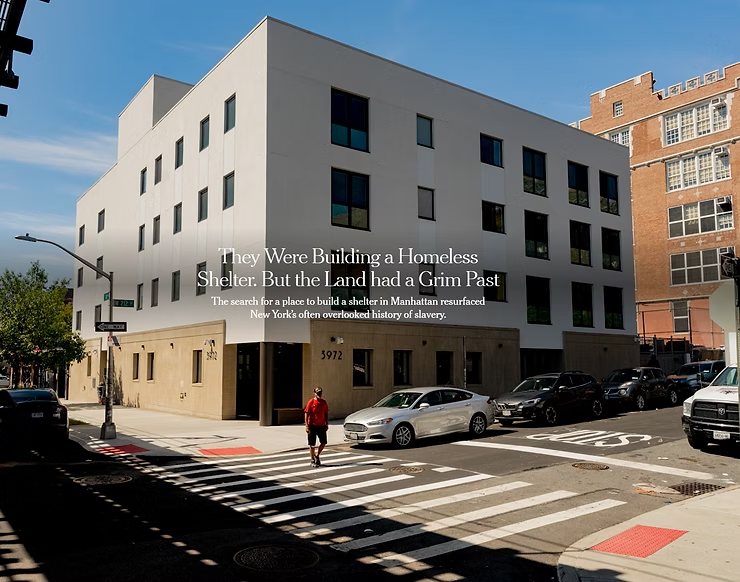
The Complex History of the Site of BRC’s Inwood Shelter and Memorial Featured in the New York Times

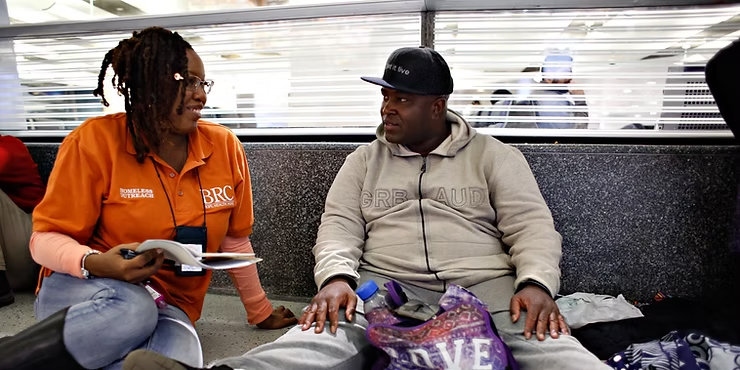
Well over 200 outreach and case management staff (FY23: over 250 outreach and case management staff) work 24/7/365 throughout New York City’s subways, transit hubs and streets to help people find their maximum level of self-sufficiency, ideally leaving a life unsheltered and moving to permanent housing. All of BRC’s outreach teams work with individuals experiencing homelessness to motivate them to accept services that will get them off the streets both initially and for the long term. BRC’s outreach teams are trained to look beyond the surface, and to communicate with love and respect to individuals that are often poor, ill, scared, and traumatized by a lifetime of being let down by systems which were supposed to support them.
We utilize a trauma-informed model of engagement to meet unsheltered New Yorkers where they are: we succeed by listening and motivating. Our clients are resilient and resourceful: they are experts at surviving in very difficult circumstances. BRC outreach workers have a challenging job convincing these men and women to let us help them. And while not every client agrees to come inside the first attempt, many do. Many more do so after additional contact with outreach workers. BRC’s outreach staff offers help, but doesn’t force, in order to send the message that we will be there to help them when they ask us to do so. And we keep coming back, establishing a relationship and earning trust.
We have many partners. The City of New York, through the Department of Homeless Services (DHS), the State of New York, through the MTA, and Amtrak, all invest in our efforts. We are in the city subways 24 hours a day, each and every day, as well as at Penn Station and Grand Central, where we have offices and dedicated staff (at Penn at the foot of the escalator at 32nd and 7th, and at GCT on the lower concourse, next to the police substation). You may even see us at a Metro North or Long Island Railroad station north and east of the City. We’re also fortunate to partner with two of Manhattan’s business improvement districts (BIDs): the Downtown Alliance and the East Midtown Partnership, where we work with community and business leaders to help, not harass, people in need.
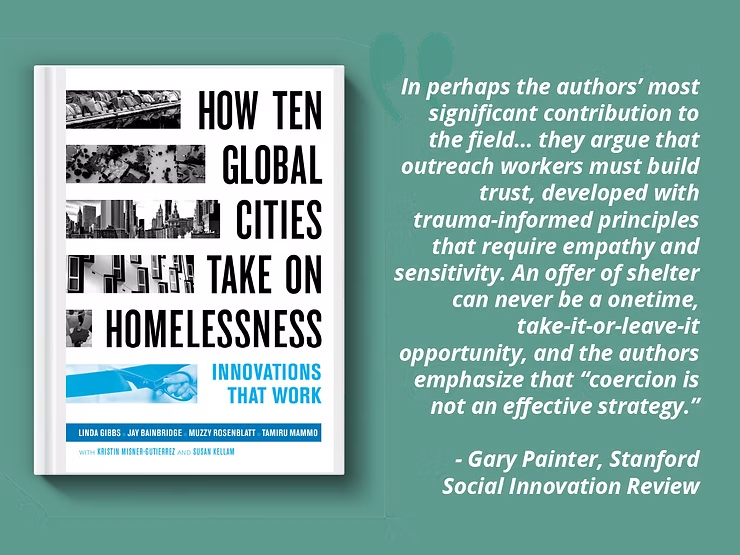
BRC’s homeless outreach model utilized by BRC was recently reviewed by the Stanford Social Innovation Review (SSIR), as part of the publication’s review of “How Ten Global Cities Take On Homelessness: Innovations that Work,” co-authored by BRC’s President & CEO Muzzy Rosenblatt. The SSIR notes that BRC’s homeless outreach model represents “a significant contribution to the field,” noting that in order to assist individual experiencing homelessness “outreach workers must build trust developed with trauma-informed principles that require empathy and sensitivity. An offer of shelter can never be a onetime, take-it-or-leave-it opportunity, and the authors emphasize that coercion is “not an effective strategy.”
In addition, BRC regularly submits to external evaluation and is proud of the recognition that we have achieved, including being awarded the New York Nonprofit (NYN) Cause Award, being named as a finalist for the Drucker Prize for Nonprofit Innovation, and receiving New York Community Trust Nonprofit Excellence Award, and many others.
In 2019, BRC’s homeless outreach programs funded by NYS MTA and NYC DHS were the focus of two NYS Comptroller audits, as well as an investigation by the MTA Inspector General. BRC believes that the NYS Comptroller audits failed to accurately recognize and represent critical components of effective and successful outreach. The MTA Inspector General report, released in June 2020, confirmed this opinion, and BRC was successful in bidding for, and winning, the most recent NYC DHS subway outreach contract, which went into effect on October 1, 2020 and has an annual value of more than $22 million.
While mischaracterizing BRC’s subway outreach work, BRC is committed to organizational learning and improvement, and continues to improve our programs to address identified inefficiencies and weaknesses identified within existing outreach operations and BRC’s contracts with the City and State.
In June 2020, after an 11-month investigation, the MTA Inspector General concluded that BRC performed consistent with its contractual responsibilities, and that the MTA must improve how it sets its goals for addressing homelessness and more clearly define these in its contracts and communications. Regarding BRC’s Penn Station and Grand Central Terminal homeless outreach staff, the report acknowledges that “there are many required activities that take place out of sight,” and which “can take hours.” In its review of worker time and BRC invoices, an army of investigators “did not find fraud.”
Aug 24, 2021 | 10 Global Cities

Jul 1, 2026 | Press | Staff Story
Sep 21, 2025 | Inwood